Showing posts with label but. Show all posts

Monday, 8 September 2014

Does my bum look big in this?

The subconscious ‘but’ has been mentioned. I thought the following might be helpful.

M’reen: You may have noticed that I have used ‘but’ twice (in the article).
Before each ‘but’ there was a positive point and the ‘but’ killed that point dead.
So, as one client observed, “yes that dress looks nice but your bum looks big” is guaranteed to get him
into trouble. BUT, if he said, “that dress looks nice even though your bum is big” he can live to see another day. So, avoid ‘but’ like the plague and try changing the sequence of the comment:  
‘Even though your bum is big you look nice in that dress.’


“I’ll respect that you don’t want to but I won’t respect that you can’t.”
“I won’t respect that you can’t but I’ll respect that you don’t want to.”
Which feels best to you if it was a comment on your statement?

Having seen a post mentioning the subconscious 'but' I thought I'd post this - it's nothing very clever but 
if you've not seen it before it can make a huge difference to your life.
It's good for clients, too.      Look at this:
"I need to earn more BUT I'm not sure how I could ever do that..."
and compare it with this:
"I'm not sure how I'm going to do it BUT I'm going to earn more..."               

BUT is the mind's eraser. It erases everything that went before it...
so you might as well put the negative part before the BUT
and make sure that the last thing your mind accesses in the statement is what you WILL do, 
rather than why you can't.              

Think of it as 'but reversal' and it helps it stay in your mind.                         

On a similar subject, if you link "should" or "shouldn't" with 'and' instead of 'but',
you can easily make positive changes in your life.                                 

"I know I should get more exercise BUT I really don't have time..." lets you completely off the hook 
(been there, done that!)   
Whereas: "I know I should get more exercise AND..." doesn't easily allow you to negate 
the intent of what you've just stated.                            

'BUT' is a very powerful word it can help or hinder your progress in life
and do either just as effectively.            

Apologies if you're now thinking "Well, why on Earth did he post that? I already knew that!" - 
it's just that I know a lot of people forget it and it REALLY helped me to achieve the success 
that I have managed over the last few years. Terence               

I've used the 'yes...but' and the 'yes ...and'  as part of training that I run with teachers. 
I use it to show how the BUT simply closes the door to communication and the AND can open it. 
Its quite fun to see a room of people going through the YES ..AND after a YES >>BUT 
and hearing the laughter and excitement that can be generated.               

I have been getting clients to reframe in this way for some time now as a piece of homework, 
it's quite surprising how much habit resistance there is at the outset but at the end of a week 
they really can make changes without tears.

I tend to avoid shoulds and musts like the plague as they tend to be guilt trips imposed by others. 
Ask yourself, ‘what will happen if I don’t?’

Unfortunately I don’t have the author of the above so if you recognise this piece
please give me their name so that this piece can be appropriately credited.

Perhaps you’d like to check out my sister blogs:
http://www.ourinnerminds.blogspot.com     this takes advantage of the experience and expertise of others. 
www.turbochargedreading.blogspot.com    describes the steps to reading in the way your mind prefers.
www.happyartaccidents.blogspot.com       just for fun.

To quote the Dr Seuss himself, “The more that you read, the more things you will know.                             The more that you learn; the more places you'll go.”

Monday, 21 April 2014

Words that can get you into and out of trouble.

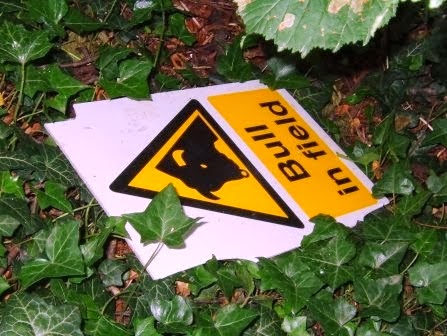
Photo by M'reen, this amused me as it was hidden deep under a hedge!   

Words that can get you into and out of trouble.
M'reen


I am a Sagittarian and I once read something along the lines of ‘what you think you heard me saying wasn’t what I actually said, because what I said has flipped over between my mouth and your ears.’
Also, that we Sagittarian will throw something into a conversation just to see how it bounces
with no investment in the outcome.
Whenever your birthday the following realisations can come in useful when facing a disagreement with someone you want to remain friends with.

WHY?
Why is generally a word to avoid unless it is qualified.
Why is a challenge that produces a defensive posture in the listener.
Just pose some why questions in your mind. They imply that you are wrong, stupid 
and all sorts of negative stuff; particularly if spoken in ‘that’ tone of voice!
Now try qualifying. Preface the WHY with, “I’m really curious why you,” “I’m really interested 
in understanding why …”; said in a genuinely caring or needing to understand tone of voice.

not YOU
You will notice that when you qualified WHY you used:
 ‘I’(am curious why …) and not ‘you’ (‘Why did you ….’).
Try. ‘you make me sick!!!’      Now try, ‘I feel sick when you… ‘
       ‘you always …..’                Now try, ‘I always feel … when I you …. (try to change the you)’
 ‘I always feel …. when I hear you say …’ Now try and take it a step further and avoid the ‘you’
‘I always feel ….  when I hear (and repeat the sentence)’
Now you’ve got two ’I’s’ in the conversation.
This is taking responsibility for your feelings.
It is not putting responsibility for your feelings onto the other person.
I find this rather difficult to do in the heat of the moment.
In the heat of the moment you are not at your professional best; you just react. A black belt in a number of arts told me that when faced with a terrifying situation you forget your training and run.
So when listening to or watching a drama, consciously listen for the ‘YOUs’ and then change 
the sentence to an ‘I’ one, in this way you will have a chance of hearing yourself speak 
and so have the opportunity to defuse the situation.
In my experience, if you stop yourself and repeat the sentence without the ‘you’
then the other person who has not played the ‘taking responsibility for my own feelings’ game
will also stop themselves and substitute ‘I’ for ‘you’. And with this mutual respect and care you feel free to express yourself fully and are more fully able to listen to the other person.


BUT
A client expressed this rather well.
If I say to my wife:
‘You look nice in that dress but your bum is big’ then I’d better hide behind the settee.
‘You look nice in that dress, however your bum is big’ I might stand a chance of living another day.
‘Even though your bum is big, you look nice in that dress’ and I get to enjoy a lovely evening.
The fact is that no matter how much or for how long you praise something as soon as you say BUT you destroy everything that you have said or written before the BUT.
Try it, try and compose a positive sentence that is not ruined by BUT.

You might put BUT after a full stop as an emphasis as to how the situation can be improved.
When doing this I will pause after my negative statement. Emphasise BUT. Pause again.
Before completing what I want to say. In this way I have effectively disconnect myself 
from the start of the sentence and can now offer a solution.

If you find yourself stuck in mid sentence, soften the blow with HOWEVER or EVEN THOUGH.
However, the best option is to put the end of your sentence at the beginning.

AND? and BECAUSE? Even a gentle WHY?
When said in a positive way AND? and BECAUSE? are enabling words.
They express interest without imposing your own thoughts.
A raised eyebrow or open palms ask the same question.
However anything can have opposite effects depending on your intent.
A gentle ‘because’ can lead a person deeper and deeper into their experience
whereas as a persistent ‘because’ can become increasingly aggressive.